By: Quod Libet
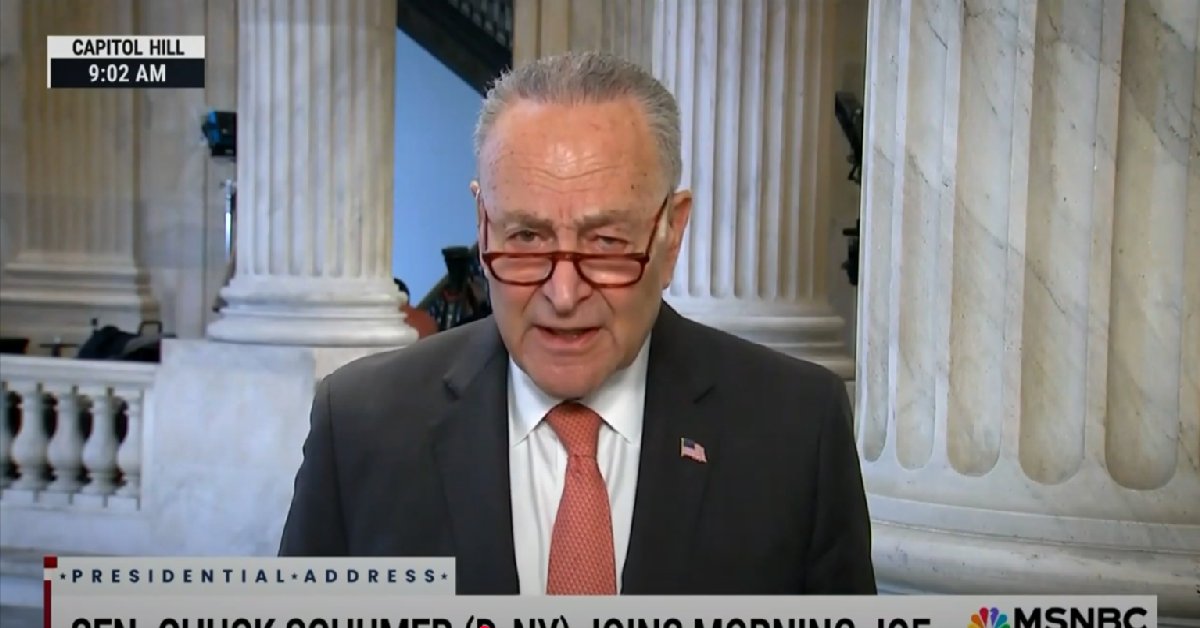
From a March 14, 2025, Roll Call article (edited for brevity): Senate Minority Leader Charles E. Schumer said Thursday that he’ll vote to advance a House-passed stopgap funding measure needed by Friday night to avert a partial government shutdown. Schumer said that a shutdown would be worse than passing the Republicans’ Continuing Resolution. Schumer opined, “It wasn’t much of a decision; it was more like a Hobson’s Choice: either proceed with the bill before us or risk Donald Trump throwing America into the chaos of a shutdown.”
The expression “Hobson’s Choice” has become rather cliché these days, and its misuse is also quite common. Schumer finds himself between a rock and a hard place politically. On the one hand, he says he is strongly opposed to passing the Republican-backed Continuing Resolution, thus admitting political defeat and signaling a Trump victory. On the other hand, he is immovably committed to avoiding a government shutdown. But is that a Hobson’s Choice? No, Hobson’s got nothing to do with Schumer’s political pickle.
Schumer is presented with two options: one bad and one worse. When two evils confront you, and you’re forced to choose the lesser, that unenviable predicament is correctly referred to as a classic “dilemma.” A good example of a dilemma is the game “Would You Rather?” Would you rather kiss my foot or my bottom? Would Schumer rather vote in favor of a Trump proposal (political surrender) or see his constituents and his party suffer the perceived (exaggerated) effects of a government shutdown? Such is Schumer’s DILEMMA.
A sort of dilemma in which people are faced with two equally bad options is known as a “Morton’s Fork.” In this scenario, hapless victims find themselves in a lose-lose situation. You’re “damned if you do, and damned if you don’t.” The outcome of a Morton’s Fork situation is certain to be unfavorable, as either result will be as undesirable as the other. In the movie True Grit, the female lead weighed two speculative threats from the Texas Ranger who suggested a kiss or a spanking: She insisted, “One would be as unpleasant as the other.”
The devil, or the deep blue sea? Good question. Accept the wretched life as a conscripted, oft-sodomized, ocean-going slave, subject to indiscriminate flogging and worse, or walk the plank to a certain and swift death by drowning in shark-infested waters? Take your pick. In the words of Jack Benny, “I’m thinking, I’m thinking.”
John Morton served under Henry VII. He was made Lord Chancellor in 1487. He proposed a benevolence tax to be levied only on those citizens who could afford it. Which citizens, you ask? He rationalized that everyone living extravagantly was obviously rich and that those living frugally must be quietly saving money. Therefore, the tax applied to everybody, rich or poor. Thus, the expression Morton’s Fork was born.
Finally, we’ll define Hobson’s Choice, not to be mistaken with Sofie’s Choice or Portnoy’s Complaint. When you’re making a deal, whether you’re the seller or the buyer, and the negotiations reach a point of “Take it or leave it,” that’s a Hobson’s Choice. The seller might say, “This used bike is $100; take it or leave it.” Or the buyer may say something similar, “I’ll give ya $100 for the bike, take it or leave it. In a dilemma and a Morton’s Fork, two choices present themselves, albeit neither of which is favorable.
But in a Hobson’s Choice, one (and only one) choice is offered. So, there may be an illusion of choice, but the two options are: take what I’m offering, or take nothing at all, which for all intents and purposes leaves only one choice. Accepting nothing isn’t really a choice, but I suppose there’s room here for a semantic argument. Thomas Hobson was an English livery stable owner who offered customers the choice of renting the horse in the stall closest to the door (and only that horse) or no horse at all. The customer may fancy another horse, but Hobson’s Choice left them no option except one. Ergo, a Hobson’s Choice is literally take it, or leave it.