By: Cassandra McBride | Ammo.com
Report Highlights: For decades, Americans have had to choose whether to exercise their Second Amendment rights or use marijuana for pain management and ailments. That legal landscape is finally shifting.
- Federal law prohibits medical marijuana and recreational marijuana users from purchasing and possessing firearms.
- The Supreme Court held that occasional marijuana use alone does not grant the federal government the authority to infringe upon the Second Amendment rights of Americans.
- The ATF is relaxing restrictions on the Second Amendment, while the FDA is relaxing restrictions on cannabinoids and marijuana products.
What Is the Law Regarding Guns and Marijuana?
Initially passed in the 1968 Gun Control Act and expanded upon to include prohibited persons over the years, 18 U.S.C. 922 § (g)(3) prohibits anyone who unlawfully uses a controlled substance, as defined by the Controlled Substances Act, from owning firearms. It’s not specific to marijuana. It includes every controlled substance. However, marijuana is worth talking about specifically because of its quasi-legal status, including in a number of relatively gun-friendly states such as Arizona, New Hampshire, Texas, and Wyoming.
Despite the unanimous (9-0) Supreme Court ruling in favor of a young man who was prosecuted for owning a pistol while admitting to occasional marijuana use (U.S. v. Hemani 2026), it is still technically illegal to use marijuana and own guns.
If you’ve ever filled out a Form 4473, you’re familiar with Question 21f: “Are you an unlawful user of, or addicted to, marijuana or any depressant, stimulant, narcotic drug, or other controlled substance?” For decades, there was no ambiguity concerning medical or recreational marijuana use. The latest Supreme Court ruling narrows the scope slightly, but the bold warning underneath the question remains:
“Warning: The use or possession of marijuana remains unlawful under Federal law regardless of whether it has been legalized or decriminalized for medicinal or recreational purposes in the state where you reside.”
Regardless of what one thinks about marijuana, or the right of the federal government to regulate drugs or the internal laws of the various states, the fact remains: As of now, possession, sale, and cultivation of marijuana remain a federal offense. Recreational marijuana is a Schedule I drug in the same category as heroin. In April of 2026, FDA-approved cannabinoid and marijuana products were reclassified as Schedule III drugs.
18 U.S.C. 922 § (g)(3) is a particularly difficult issue for people who use medicinal marijuana for bona fide medical purposes, rather than as a sort of legal loophole to consume marijuana legally. Many people use medicinal marijuana for a variety of purposes, including relief from pain, Alzheimer’s symptoms, glaucoma, epilepsy, and a number of complications related to cancer, including nausea and lack of appetite. The science on this is rather conclusive, so much so that Big Pharma makes legal synthetic THC pills known as Marinol.
In United States v. Rahimi (2024), the Supreme Court held that the federal government may disarm “dangerous individuals.” The Hemani ruling slightly narrowed the scope of existing laws, which were once applied to all drug users, regardless of whether they were actually dangerous or not.
Can Medical Marijuana Users Own Guns?
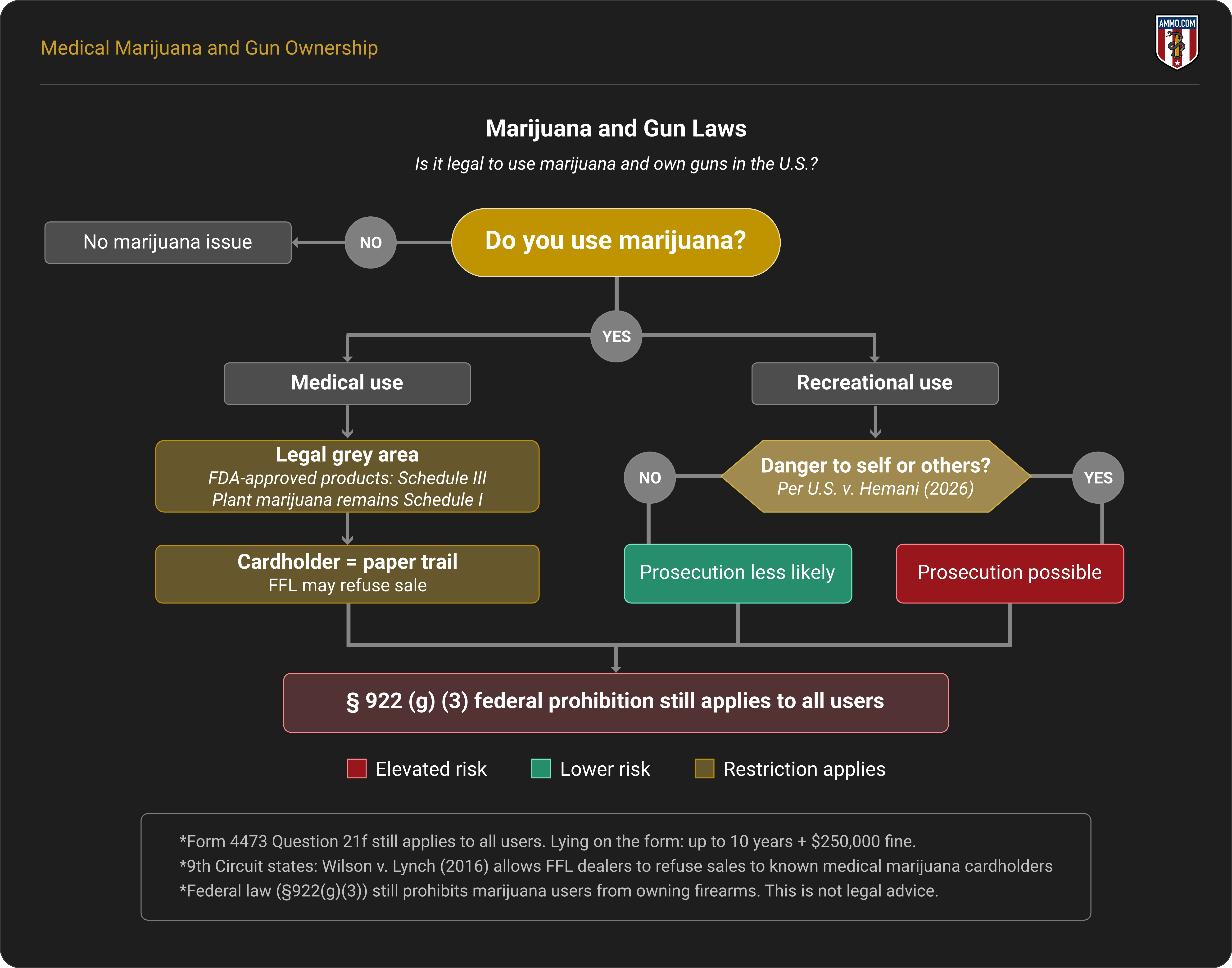
After the U.S. v. Hemani Supreme Court ruling in 2026, medical marijuana users who own or possess firearms remain in a legal grey area. The Bureau of Alcohol, Tobacco, Firearms and Explosives (ATF) will provide further guidance, but at the time of writing, that guidance has yet to come down the pipeline.
Another caveat for gun-owning marijuana users is Circuit Court rulings. In 2016, the 9th Circuit Court ruled in Wilson v. Lynch that FFL dealers were bound to Form 4473 21f, where unlawful drug users are prohibited from owning firearms, and therefore unable to sell to the users. However, this ruling is currently binding in nine states and two territories (Alaska, Arizona, California, Hawaii, Idaho, Montana, Nevada, Oregon, Washington, Guam, and the Northern Mariana Islands).
The Wilson ruling applied an outdated Constitutional Framework (intermediate scrutiny), whereas Hemani applied the historical analog framework prescribed in Bruen. Unfortunately, the Wilson ruling may still apply to those nine states in 2026.
For now, medical marijuana users can still be barred from purchasing or possessing firearms. The federal government just has to be more discretionary in its prosecutions.
Can Recreational Marijuana Users Own Guns?
Federal law still prohibits recreational drugs, including marijuana, and gun ownership. However, occasional use of Marijuana does not automatically mean the federal government can infringe upon the user’s Second Amendment rights.
In the Hemani case, federal agents discovered a pistol and marijuana during an unrelated search of Ali Hemani’s home for alleged terrorism. Hemani was cooperative during the search and admitted to smoking marijuana every other day. The Department of Justice prosecuted Hemani and charged him with a felony months after an unrelated search under 18 U.S.C. 922 § (g)(3).
Although the Supreme Court has ruled that occasional recreational use does not automatically mean a person is too dangerous to exercise their rights, the federal government is also responsible for determining whether someone is too dangerous to exercise those rights. Therefore, gun owners should be aware that consequences could accompany recreational marijuana use.
What Are the Penalties for Ignoring the Law?
We are not encouraging anyone to break the law. Indeed, the penalties for doing so with regard to firearms are always stiff. Using and possessing marijuana are no exceptions. So what are the penalties gun owners could face for smoking pot?
First, violation of 18 U.S.C. 922 § (g)(3) can result in up to 15 years in federal prison. But what happens if you lie on Form 4473 to obtain a firearm in the first place? Well, lying on that form could result in 10 years in federal prison and a $250,000 fine.
Second, some marijuana users may still be subject to prosecution. Although the narrowed scope of the application of the law provides some protections, the government still has the authority to deem a civilian as “too dangerous” to own a firearm.
To summarize, it is against federal law to use marijuana (even medicinally with a card) while owning a firearm. But for the first time in decades, gun owners have a glimmer of hope.
What’s the Deal With Enforcement?
In 2026, the government’s stance on gun ownership, marijuana, and enforcement of the law seems ambiguous. A glimmer of hope was given to Second Amendment supporters when the Trump administration hinted at pro-2A revisions to Form 4473. The administration also seems to be reversing course on a previous stance that seemed to support gun rights infringements for cannabis users.
Prosecutions aside, the FBI has a history of denying background check approval for gun purchases due to unlawful substance abuse. Estimates suggest that more than 148,000 Americans were denied gun purchases under this category. More recent background check data shows that nearly 11,000 people were denied in 2023, and 9,163 were denied purchases in 2025.
Of course, it isn’t just marijuana users who fall into the “unlawful substance use” category. But medical marijuana and recreational users have been denied their defensive rights during this administration. Under Acting Attorney General Todd Blanche, the ATF is rolling back many restrictions, so there’s a chance that the Second Amendment will prevail.
Historically, however, the legal pretext for charging otherwise law-abiding gun owners because of their use of medical marijuana is the Gun Control Act of 1968, which was passed at the height of American conservatism’s war on hippies and weed. This law remains on the books.
The purpose of this provision of the law at the time was to create an easy way for the feds to hand out sentence enhancements for drug dealers or domestic terrorists who were also potheads, due to the strong presence of cannabis use among the counterculturalists who populated the far left during this time period. If we’re going back to the original intent, this provision was not crafted with now-legal medical marijuana users in mind. This is an important point to raise because of the mental health issues alluded to above – this law was not designed for such problems.
As such, there isn’t really an enforcement apparatus targeting Americans under this specific law, nor can federal authorities realistically enforce it on a large scale. There are likely tens, if not hundreds, of thousands of medical marijuana users in the United States who also own otherwise legal firearms. There is also the specter of people who are involved in the legal marijuana trade who have absolutely nothing to do with cultivation or sale, such as security guards, who often carry firearms and may be in violation of this law. For the feds to begin targeting such otherwise law-abiding citizens would mean either a massive crackdown on a significant part of the population or the use of a few high-profile cases to set an example for everyone else.
If this law were enforced in any systematic manner, medical marijuana dispensaries would have no means of defending themselves from criminals, because their security guards couldn’t be armed with anything currently classed as a firearm. This and the generous tax revenues that flow from it are primarily why state governments have chosen to look the other way on enforcing or helping to enforce this aspect of federal law. Not only are there tons of people violating it, but consistent, rigorous enforcement would lead to a significant drop in state tax revenues, which would, in turn, lead to significant cuts in social services offered by state governments.
Is it Constitutional to Prohibit Medical Marijuana Users From Possessing Firearms?
The answer to whether it is Constitutional for the government to infringe upon the right that ‘shall not be infringed’ may seem obvious to ideological purists. But in regard to whether a person’s actions can welcome infringements, is medical marijuana the hill that anti-gun politicians really want to die on?
Perhaps.
Prior to Ali Hemani’s disarmament over pot, Second Amendment cases involving cannabis or marijuana were never brought before the Supreme Court. Even then, Hemani’s case was more focused on recreational use than medical marijuana.
A Philadelphia-based doctor named Matthew Roman filed suit after a licensed firearms dealership didn’t allow him to purchase a firearm after he answered this notorious question honestly. However, his argument wasn’t focused solely on the Second Amendment (and it’s a good thing, because the courts generally do not agree with our “no exceptions” view of the Second Amendment). Rather, he appealed to the Fifth Amendment, which protects Americans from self-incrimination, in addition to the Second Amendment, which doubtless all our readers know by heart.
Indeed, the question specifies that the person has used medical marijuana “unlawfully,” which is a dubious question: Should the federal government maintain jurisdiction over the states in this regard?
There are certainly arguments in either direction, and it makes sense that so many Americans are cynical in this regard. At the very least, the Trump Administration seems to have declared a truce on this matter, looking the other way as more states increased legalization of marijuana, both medical and recreational, throughout the country, ending the catch-22 harassment of the Obama Administration, which targeted otherwise legal (and tax-paying) medical marijuana facilities on the grounds that they were paying tax on illegal income.
Seriously, that happened.
In 2023, Republican Congressman Alex Mooney of West Virginia introduced legislation to bring federal gun laws into alignment with the increasing legalization of medical marijuana at the state level. This bill only recognized medical marijuana use and would do nothing for the millions of Americans currently living in states where recreational marijuana is not just legal, but a booming business.
Florida Congressman Brian Mast also introduced legislation to protect recreational marijuana users’ gun rights in 2023. Neither of these bills passed.
How Will This Impact My Right to Concealed Carry?
For those who like to carry concealed, the challenge is twofold: Not only must they potentially give up their guns, but they must also give up the practice of carrying concealed when in public.
Recent Supreme Court rulings have done nothing to ensure concealed carry rights, and Congress hasn’t acted either. Keep in mind, federal law currently prohibits “possession” of a firearm, not just acquisition. At the federal level, it will likely be up to Congress to say “law-abiding medical marijuana users (and maybe even proud potheads) can legally carry concealed firearms to defend themselves.”
There was a state-level effort in 2019 to extend the right to carry concealed firearms to medical marijuana patients in Colorado, but it was ultimately unsuccessful. And, indeed, in our research, we were not able to find a single state that took the additional step of not just allowing medical marijuana users to own firearms under state law, but also allowing them to carry concealed without molestation.
This is all, of course, a bit of a moot point anyway for those looking to stay within the good graces of the law. Because what good is the right to carry a concealed firearm if you don’t have the right to own a firearm?
The Federal Government Must Address This Disparity
Federal legislation is needed in this regard because the state laws protecting the right of otherwise law-abiding medical marijuana users to own firearms mean very little to the federal government. The state law isn’t what is at issue here. It is the federal law that requires change. Either that, or the federal government needs to begin rigorously enforcing its laws regarding marijuana – but there is simply no political appetite for this. Particularly with an opioid epidemic ravaging the country, marijuana cultivation is pumping badly needed money into economies ravaged by deindustrialization. What’s more, there is some evidence (though it is far from conclusive) that medical marijuana might be an important and useful tool in the fight against opioid abuse.
There is also the question of the unintended consequences of this law, which are twofold. First, there is the very real possibility that otherwise law-abiding gun owners will turn to the black or gray market to purchase their firearms out of paranoia that the federal government will target them if they wish to obtain one legally. This might sound far-fetched, but after the hysteria surrounding the Chinese coronavirus and the civil unrest of the summer of 2020, there is no reason to believe that every otherwise law-abiding citizen will just forfeit their right to self-defense because the federal government has forced them to choose between that and pain management or epilepsy.
The flip side of this is all the law-abiding citizens who choose their doctor-recommended treatment of medical marijuana over the right to keep and bear arms. This scenario is much more likely than the previous one, and it’s not a neutral position. People choosing to exercise their Second Amendment rights is a net social positive in addition to simply being a Constitutionally enumerated right. Stripping otherwise law-abiding citizens of their right to keep and bear arms will, conversely, have a net negative social effect in addition to being a violation of their rights.
State sovereignty issues likewise enter into the equation. While a certain degree of federal supremacy is a moot point after the American Civil War (to say nothing of the expansive view of the interstate commerce clause), it does seem like a massive amount of federal overreach, allowing the feds to effectively strip Second Amendment rights from a group of people who are not breaking any laws in their state. This is particularly egregious because the federal government seems to have largely given up trying to get these states to comply with the federal law that, at least in theory, supersedes it.
Otherwise, legal gun owners are thus thrust into making a difficult decision between their rights and the law – a decision that is made particularly cruel thanks to the federal abdication of enforcement.
So which legal decision should you make? That’s not a question we can answer for you. It’s one that only you can answer for yourself after careful consultation with your physician and by weighing your options regarding the potential for a self-defense situation, should one arise. Indeed, because it is disproportionately seniors and the ill who are using medical marijuana, this makes the decision an especially cruel and tragic one. However, until federal law catches up with the medical marijuana laws of your state, it is an unfortunate choice that you must make if you don’t want to end up on the wrong side of the law, facing 15 years in prison.
Sources
-
18 U.S.C. § 922 – Unlawful Acts law.cornell.edu
-
21 U.S.C. § 802 – Controlled Substances Act Definitions law.cornell.edu
-
United States v. Rahimi – Supreme Court Opinion (2024) supremecourt.gov
-
Wilson v. Lynch – U.S. Court of Appeals, 9th Circuit (2016) law.justia.com
-
Hawaii Medical Cannabis Registry – Law Enforcement health.hawaii.gov
-
Revising the Firearms Transaction Record (Form 4473) – Federal Register federalregister.gov
-
H.R.363 – 118th Congress (Rep. Alex Mooney) congress.gov
-
H.R.2772 – 118th Congress (Rep. Brian Mast) congress.gov
-
Medical Cannabis and the Fight Against Opioid Abuse – Mayo Clinic Proceedings mayoclinicproceedings.org